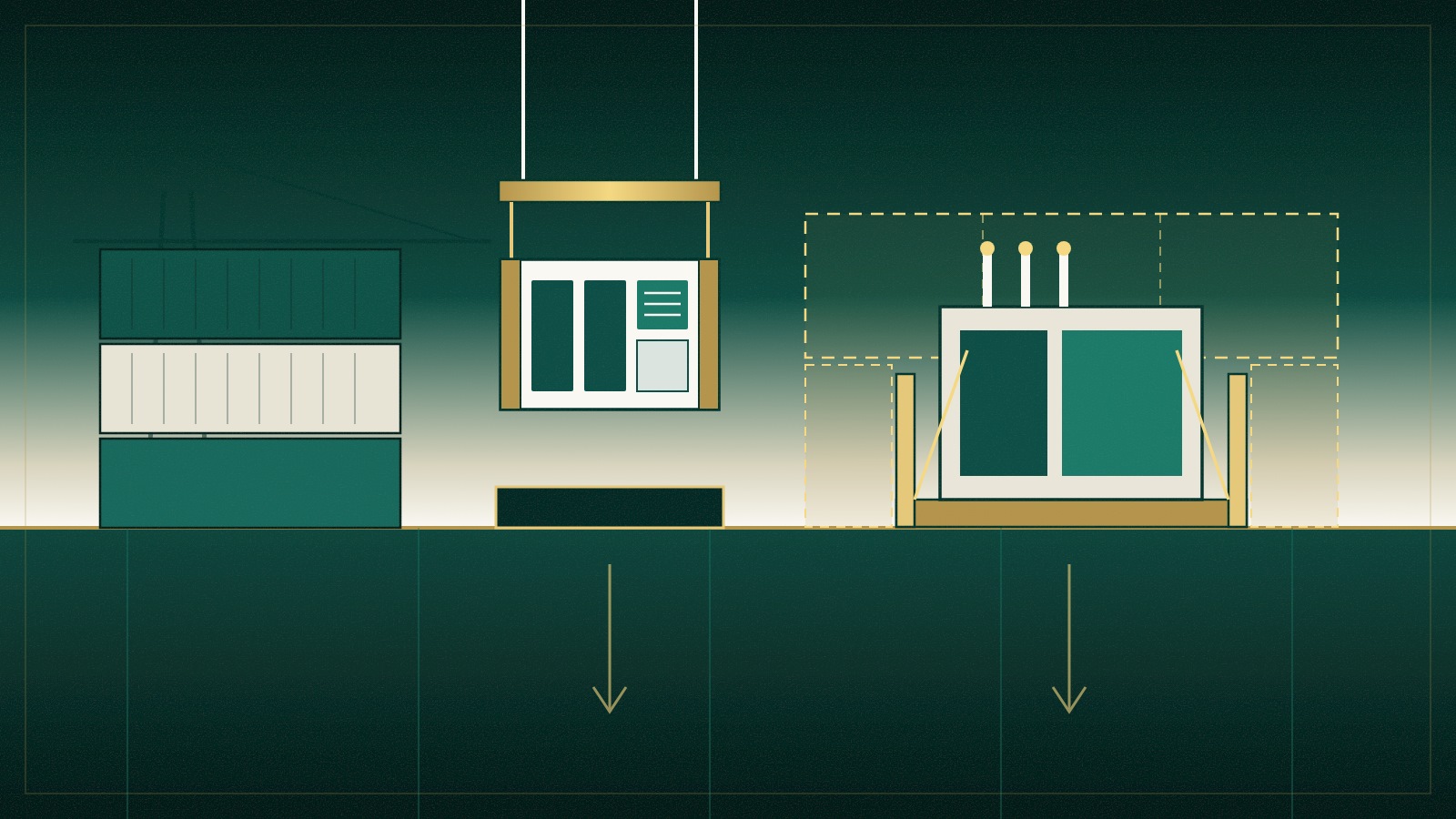
1. Weigh-Out vs. Cube-Out: Why Dense Energy Cargo Starves in Standard Fleets
Global liner shipping was engineered for volumetric consumer goods. Roughly 64% of the world's marine containers are 40-foot dry and 40-foot high-cube boxes carrying furniture, apparel, electronics, and palletized solar photovoltaic modules that fill all 76 cubic meters of interior space long before hitting structural weight ceilings. Energy-transition manufacturing runs in the opposite direction: grain-oriented electrical steel (GOES, HS 7225.11), copper wire rod (HS 7408.11), lithium-iron-phosphate battery racks, and medium-voltage substation skids hit weight limits when three-quarters of the box is still empty air.
Under ISO 668 structural standards, both a standard 20-foot dry container and a standard 40-foot high-cube container share the exact same 30.48-metric-tonne Maximum Gross Mass (MGM) ceiling stamped on their Convention for Safe Containers (CSC) safety plate. Because a 40-foot steel box weighs roughly 3.95 tonnes empty (tare) versus 2.25 tonnes for a 20-foot box, the smaller 20-foot heavy-tested container actually carries more legal cargo payload (27.2 to 28.2 tonnes) than a 40-foot container (26.5 tonnes). When a European or North American transformer factory orders 500 tonnes of Japanese or Korean GOES steel coils, every single coil must move in heavy-tested 20-foot containers (roughly 11.5% of the global fleet) engineered with reinforced cross-members to handle intense floor point-loading.
"Tracking the Shanghai Containerized Freight Index for 40-foot dry boxes tells a grid procurement officer almost nothing about special-equipment scarcity. When Red Sea or Panama detours freeze empty repositioning, 1.8% flat-rack pools and 45-tonne heavy-lift slots dry up weeks before standard spot rates peak."
Energy Solutions Intelligence, Special Equipment Audit (SC-313)Chokepoint detours distort heavy and special container pools far more severely than standard 40-foot dry boxes. When vessels reroute around the Cape of Good Hope, container round-trip turnaround stretches by 20 to 28 days. Ocean carriers naturally prioritize empty repositioning of standard 40-foot dry boxes back to Shenzhen and Shanghai where retail booking velocity is highest, leaving empty collapsible flat-racks, open-tops, and heavy-tested 20-foot units stranded in Rotterdam, Antwerp, or Savannah depots for weeks.
2. The 5 MWh BESS Shock: Shipping 41 Tonnes Inside a 20-Foot Footprint
Over the past 24 months, utility battery storage OEMs have packed 314 Ah LFP cells so densely that flagship 20-foot containerized BESS units (HS 8507.60) jumped from 3.4 MWh (~31 tonnes) to 5.0 MWh weighing 38 to 43 metric tonnes gross (41.0 tonnes modeled: 4.40t reinforced steel enclosure plus 36.60t racks, liquid cooling loops, and fire suppression). That single engineering leap broke standard ISO 668 shipping rules overnight.
Because a 41-tonne 20-foot enclosure exceeds the 30.48-tonne standard limit by more than 10 tonnes, no carrier-owned container can move it. Developers must ship each unit as a custom Shipper-Owned Container (SOC) bearing an independently certified 45-tonne Heavy-Tested CSC safety plate proving its corner castings and top-lift rails withstand dynamic sea accelerations. On board the vessel, the unit cannot enter upper deck tiers or standard 35-tonne twin-lift crane cycles; port terminals must switch to single-lift heavy spreaders rated to 45 to 50 tonnes, and stowage planners must place the box in bottom-tier heavy bays away from engine-room bulkheads and crew accommodation.
Regulatory classification compounds the bottleneck. Integrated BESS enclosures ship under IMDG Code Dangerous Goods classification UN 3536 (Lithium ion batteries installed in cargo transport unit, Class 9 Miscellaneous Dangerous Goods), requiring full UN 38.3 cell test summaries and factory-certified shipping states of charge capped at 30% SOC or lower to suppress thermal-runaway enthalpy. During a maritime chokepoint disruption, carriers blank sailings and shrink per-vessel Class 9 on-deck quotas, pushing 5 MWh BESS total door-to-door logistics from $9,750 normal ($5,950 ocean plus $3,800 heavy-haul drayage) to $17,100 per unit ($11,900 ocean plus $5,200 multi-axle heavy-haul) in crisis markets.
| Energy Cargo & Box Class | Gross / Payload | Fleet Share | Lost Slots | Door Cost (Normal) | Door Cost (Crisis) | Crisis Jump | Crisis $/Tonne |
|---|---|---|---|---|---|---|---|
| Solar PV (40ft High-Cube Dry) | 27.45t / 23.50t | 64.0% | 0 | $4,050 ($3,200 ocean) | $7,300 ($6,150 ocean) | +80.2% | $311 / t |
| GOES & Copper Coils (20ft Heavy-Tested) | 29.45t / 27.20t | 11.5% | 0 | $4,000 ($2,550 ocean) | $7,450 ($5,350 ocean) | +86.3% | $274 / t |
| 5 MWh BESS (20ft 45t SOC, UN 3536) | 41.00t / 36.60t | 0.0% (SOC) | 1 | $9,750 ($5,950 ocean) | $17,100 ($11,900 ocean) | +75.4% | $467 / t |
| Inverter / MV Skid (40ft OOG Flat-Rack) | 39.40t / 34.00t | 1.8% | 3 | $15,000 ($10,800 ocean) | $27,900 ($22,000 ocean) | +86.0% | $821 / t |
| GIS Switchgear (40ft OOG Open-Top) | 26.15t / 21.80t | 1.4% | 1 | $8,550 ($6,600 ocean) | $16,050 ($13,300 ocean) | +87.7% | $736 / t |
3. Out-of-Gauge (OOG) Flat-Racks, Open-Tops, and the Lost-Slot Multiplier
Weight alone makes cargo heavy; protruding even 10 centimeters outside the standard 2.35-meter interior width or 2.58-meter door height turns it Out-of-Gauge (OOG). Central solar inverters, medium-voltage step-up skids (HS 8504.40), and gas-insulated switchgear (GIS) modules (HS 8537.20) frequently exceed standard box dimensions by just 20 to 40 centimeters. That seemingly minor mechanical design choice drops procurement out of the 64% dry-box market into the 1.8% collapsible flat-rack and 1.4% open-top pools.
On a cellular container ship, every protruding centimeter kills neighboring revenue slots. An over-height GIS bay riding inside a 40-foot open-top container (+25 cm roof protrusion) prevents any container from stacking on top of it, triggering 1 Lost Slot surcharge ($1,950 normal to $4,200 crisis) plus specialized over-height lifting frames at both ports. That single 25-centimeter design overage pushes total crisis delivery cost from $7,300 (standard 40ft HC) to $16,050 per bay, an $8,750 penalty on every single unit.
Over-width plus over-height inverter or distribution-transformer skids loaded onto 40-foot collapsible flat-racks suffer an even steeper geometric cliff: spilling over both side rails and the upper profile blocks three adjacent cellular slots simultaneously. In a normal freight market, three lost slots ($5,400) plus flat-rack positioning ($2,200), base ocean freight ($3,200), and lowboy oversize road transport ($4,200) put door-to-door delivery at $15,000. During a chokepoint crisis, lost-slot billing alone leaps to $11,400 (3 slots at $3,800) alongside $4,800 in flat-rack scarcity surcharges, driving total cost to $27,900 per skid ($821 per payload tonne), nearly 3.8x a standard 40-foot dry container.
Source: Energy Solutions Intelligence Decimal model (container-availability-for-dense-equipment.csv). Out-of-gauge flat-racks absorb the sharpest dollar shock because dead-space lost slots escalate one-for-one with spot TEU rates.
4. The Port-Gate Road Weight Wall: Sea Payloads vs. Highway Bridge Formulas
Even when an ocean carrier clears a heavy container across the sea, dense hardware routinely stalls at the terminal exit gate. A heavy-tested 20-foot box holding 27.2 tonnes of GOES electrical steel coils weighs 29.45 tonnes gross on the vessel, completely legal under ISO 668. Once lifted onto a standard U.S. tandem-axle container chassis and tractor (~14.5 to 15.5 tonnes combined tare), total highway weight hits 44.5 tonnes (98,100 pounds), smashing straight past the 80,000-pound (36.29-tonne) federal interstate gross limit.
Moving that container inland without unpacking requires scarce tri-axle overweight chassis, state-specific overweight corridor permits (available in port-adjacent heavy-haul corridors around Houston, Savannah, and Long Beach, but strictly restricted across inland interstate bridges), or port-adjacent transloading where coils are stripped off the ocean box onto flatbed trucks at $600 to $1,200 per lift. For 41-tonne 5 MWh BESS SOCs, no standard container chassis qualifies at all: developers must contract specialized multi-axle lowboy trailers (8 to 11 axles depending on state bridge formulas), pilot escort vehicles, and utility-line clearances, turning a $850 routine port dray into a $3,800 to $5,200 heavy-haul operation per battery enclosure.
| Equipment Class | Sea ISO / CSC Limit | Port Crane Spreader Req. | U.S. Interstate Limit | EU Highway Cap | Inland Transfer Remedy |
|---|---|---|---|---|---|
| 40ft HC Dry (Solar PV) | 30.48t standard | Standard 40t twin-lift | Legal on tandem chassis | Legal (40t GVW) | Standard drayage ($850-$1,150) |
| 20ft Heavy-Tested (Coils) | 30.48t reinforced floor | Standard 40t spreader | Overweight (>21.5t pay) | Legal on 44t intermodal | Tri-axle chassis or port transload ($1,450-$2,100) |
| 20ft 45t BESS SOC (UN 3536) | 45.00t custom CSC | Heavy 45-50t single-lift | Superload (multi-axle) | Special heavy permit | 8-11 axle lowboy + escort ($3,800-$5,200) |
| 40ft OOG Flat-Rack (Inverter) | 45.00t heavy FR bed | Wire-sling / OOG frame | Over-width + overweight | Escorted abnormal load | Lowboy step-deck + route survey ($4,200-$5,900) |
| 40ft OOG Open-Top (GIS) | 30.48t open roof | Over-height frame lift | Over-height bridge check | Height-cleared corridor | Step-deck chassis or tarp strip ($1,950-$2,750) |
Source: Energy Solutions Intelligence Decimal model (container-availability-for-dense-equipment.csv). Both 5 MWh BESS SOCs and heavy flat-rack skids operate permanently beyond standard 30.48-tonne ISO gear.
On a 150-skid utility inverter and switchgear order, shipping protruding assemblies on 40-foot open-tops ($16,050/unit) or flat-racks ($27,900/unit) costs $1.31 million to $3.09 million more in crisis logistics than designing modular skids with detachable roof bushings and bolt-on radiators that pack cleanly inside standard 40-foot high-cube dry boxes ($7,300/unit). Engineering for in-gauge transport cuts ocean freight, eliminates 3-to-6-week special-equipment booking queues, and restores standard port drayage eligibility. Quantify delivered project capex impacts in our Project Finance Model.
5. Design-for-Container & Allocation Playbook for Energy Buyers
Procurement and engineering teams can neutralize special-container scarcity using four disciplined rules.
First: Mandate In-Gauge Packaging Audits During OEM Design Freeze
Before signing mechanical drawings for inverters, MV skids, or switchgear bays, enforce an explicit 2.30 m width and 2.52 m height transport envelope check. Detaching cooling fans, exhaust hoods, or roof bushings for site bolt-on takes four technician hours on site and eliminates 100% of flat-rack and open-top lost-slot billing.
Second: Verify 45-Tonne Crane & Spreader Compatibility Along the Entire BESS Route
When ordering 41-tonne 5 MWh BESS enclosures, confirm that both the load port, any intermediate transshipment hub, and the discharge port operate single-lift spreaders rated to 45+ tonnes and accept UN 3536 Class 9 SOCs without mandatory barge stripping. Never allow freight forwarders to route 41-tonne boxes through secondary feeder ports capped at 35-tonne mobile cranes.
Third: Pre-Book Heavy-Tested 20ft Pools Under Quarterly Allocation Contracts
Transformer and cable plants importing GOES electrical steel and copper rod should replace spot bookings with quarterly named-account carrier contracts specifying guaranteed 20-foot heavy-tested (30.48t MGM) empty releases at origin factories, paired with pre-contracted tri-axle chassis pools at destination ports.
Fourth: Split Dense Shipments Between Containerized Feeders and Breakbulk Backups
Whenever OOG flat-rack quotes cross $20,000 per skid or booking queues exceed four weeks, compare shifting entire inverter and transformer-skid lots onto scheduled multipurpose breakbulk liner vessels, where under-deck cargo pays strictly by cubic/weight freight-tonne without cellular lost-slot penalties.
Procurement Committee Interrogation Checklist (SC-313)
- In-Gauge Redesign Audit: Which inverter, switchgear, or transformer accessories push our cargo past 2.35 m width or 2.58 m height, and can they ship detached inside standard 40ft high-cube boxes?
- 45t CSC & UN 3536 Validation: Do our 5 MWh BESS enclosures hold current 45-tonne heavy-tested CSC safety plates, UN 38.3 summaries, and factory ≤30% SOC certificates accepted by our primary ocean carrier?
- Lost-Slot Transparency: Do supplier OOG freight quotes itemize base ocean freight, special-equipment positioning, and exact lost-slot counts separately so surcharges cannot be double-counted?
- Port-to-Site Axle Plan: For every container exceeding 21.5 tonnes payload, have we confirmed tri-axle overweight chassis availability or bonded port transloading prior to vessel departure?
6. Model Methodology and Reproducible Dataset
All payload, tare, gross-mass, and door-to-door logistics costs were computed in Python using exact Decimal arithmetic and exported to CSV. Base ocean rates benchmark Shanghai/Ningbo to Rotterdam/U.S. East Coast spot contracts ($3,200 normal / $5,800 chokepoint crisis per 40ft HC; $2,100 normal / $3,900 crisis per 20ft dry), layered with documented carrier heavyweight surcharges (HWS), IMDG Class 9 UN 3536 dangerous-goods fees, heavy-lift spreader terminal charges, OOG flat-rack/open-top lost-slot multiples (1 to 3 dead slots), and destination port drayage ranging from $850 standard tandem chassis to $5,900 lowboy oversize permits.
7. Executive FAQ
Why do 5 MWh utility BESS enclosures break standard ISO shipping container rules?
Standard ISO 668 20-foot dry containers cap Maximum Gross Mass (MGM) at 30.48 metric tonnes. A fully integrated 5 MWh LFP battery enclosure weighs 38 to 43 tonnes gross (41.0 tonnes modeled), requiring a custom Shipper-Owned Container (SOC) with a 45-tonne heavy-tested CSC safety plate, IMDG UN 3536 Class 9 dangerous-goods deck stowage, maximum 30% state-of-charge certification, heavy-lift spreaders, and multi-axle road permits.
What share of the global container fleet consists of flat-racks and open-top special equipment?
Roughly 64% of global container boxes are 40-foot dry and high-cube containers built for light consumer goods, while collapsible flat-racks account for only about 1.8% and open-top containers roughly 1.4% of global equipment pools. During chokepoint detours, empty special equipment becomes stranded in import hubs, stretching East Asian factory booking queues by 3 to 6 weeks.
How do Lost Slot Surcharges multiply freight costs on Out-of-Gauge (OOG) energy equipment?
When an inverter skid, transformer core, or switchgear bay protrudes beyond standard container height or width on a flat-rack or open-top, it blocks adjacent cellular slots on the vessel. Carriers bill shippers for those unusable dead spaces: a 40-foot OOG flat-rack consuming 3 lost slots climbs from $15,000 normal door-to-door to $27,900 ($821 per payload tonne) during a chokepoint crisis.
Why can dense copper and GOES electrical steel coils load 27 tonnes at sea but stall on U.S. highways?
While a 20-foot heavy-tested container safely carries 27.2 tonnes of dense metal coils on a ship (29.45 tonnes gross), U.S. federal interstate bridge limits cap total tractor-trailer gross weight at 80,000 pounds (36.29 tonnes), restricting standard drayage payload to roughly 19.9 to 21.5 tonnes. Shippers must book scarce tri-axle overweight chassis permits or transload coils into flatbeds near the port.