1. The Four-Axis Clearance Envelope and Freshwater Sinkage Physics
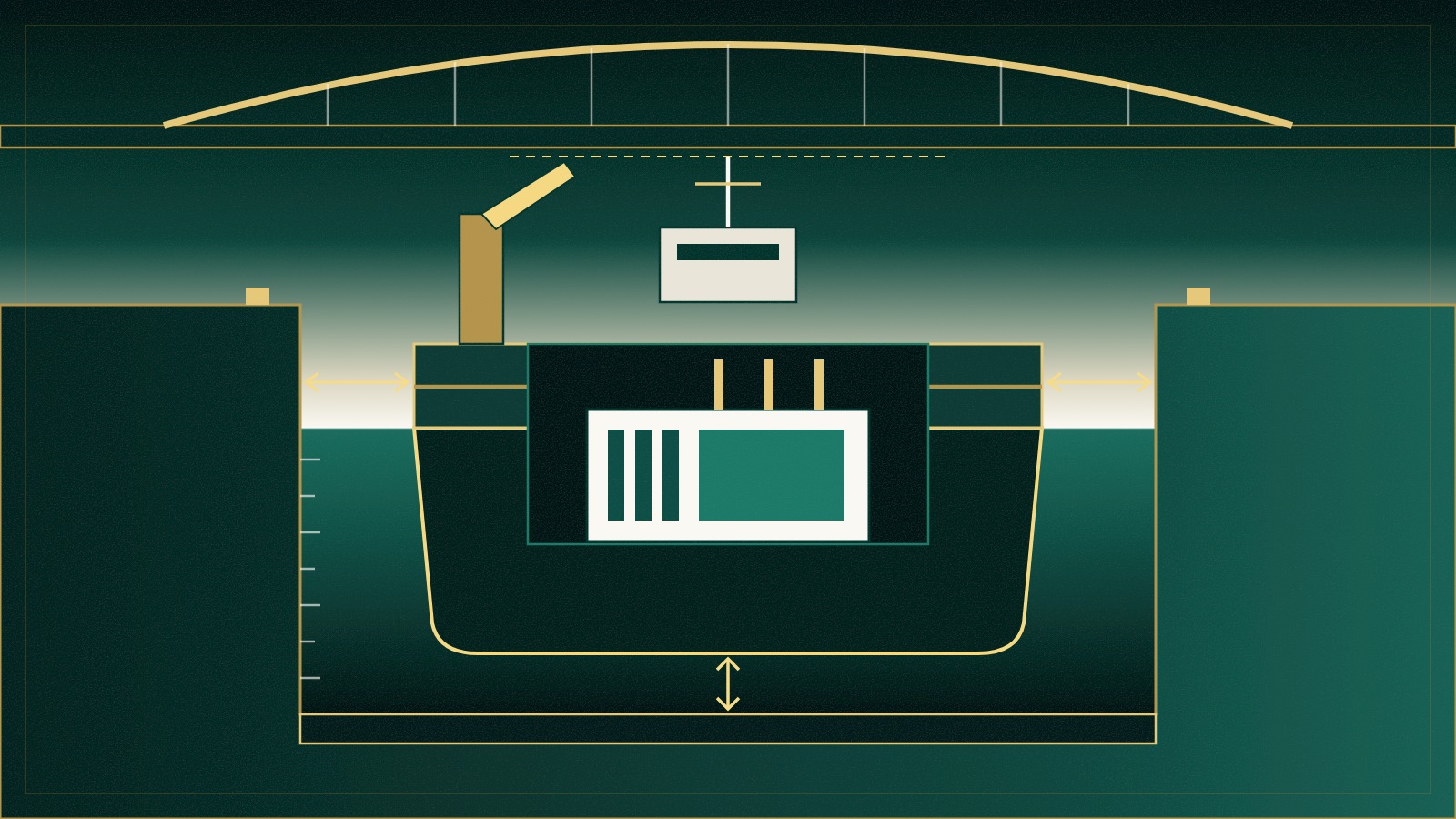
When civil engineers plan sea-to-site transport for a 320-tonne HVDC converter transformer (HS 8504.23), an industrial gas turbine (HS 8411.82), or a shipment of 100-meter wind turbine blades (HS 8502.31), draft is only one of four hard physical walls. Every maritime canal, lock, and navigable river imposes a coupled four-dimensional box: controlling water draft (including mandatory Under-Keel Clearance, UKC), lock-wall beam, lock-chamber length overall (LOA), and overhead fixed-bridge air-draft. Violating any single axis by ten centimeters turns a smooth water transit into an unbudgeted port transload.
One hydrodynamic trap routinely blindsides project planners who read saltwater vessel specifications straight off a shipbroker's datasheet: Freshwater Allowance (FWA). Open ocean seawater carries a density of roughly 1.025 tonnes per cubic meter, whereas inland canal locks fed by rivers and lakes (Panama's Gatun Lake, the St. Lawrence Seaway, and portions of the Kiel Canal and Rhine estuary) operate at 1.000 t/m³ freshwater density. When a ship moves from seawater into freshwater, Archimedes' principle drops buoyancy by roughly 2.5%, causing the hull to sink 20 to 33 centimeters deeper into the lock sill. On a 15,000-DWT heavy-lift vessel with a Tons-Per-Centimeter immersion (TPC) factor of 26 tonnes/cm, losing 30 centimeters of draft margin forces the charterer to leave 780 tonnes of cargo or bunker fuel behind at the prior port.
"Bulk grain and container boxes can shed 15% of their cargo at a canal anchorage to clear a drought draft cap. A 320-tonne generator step-up transformer cannot be sawed in half; if the vessel sits 15 centimeters too deep or one meter too wide for the lock, the entire voyage aborts."
Energy Solutions Intelligence, Waterway Dimensional Audit (SC-319)2. Engineering Dimensional Matrix Across Seven Strategic Energy Waterways
Table 1 consolidates verified design drafts, constrained low-water/drought drafts, lock beam limits, bridge air-draft ceilings, freshwater density penalties, and estimated heavy-lift bypass or transloading penalties across seven global corridors.
| Canal / Waterway | Design / Low Draft | Max Beam / LOA | Air-Draft Cap | Water Density Effect | F-500 Heavy-Lift Status | Bypass / Transload Penalty |
|---|---|---|---|---|---|---|
| Suez Canal (Egypt) | 20.10 m / 20.10 m | 77.50 m / 400.0 m | 68.00 m | Saltwater (0% FWA) | Full Clear | $0 (physical limits) |
| Danish Great Belt T-Route | 15.40 m / 15.40 m | Open / 400.0 m | 65.00 m | Brackish (~1.2% FWA) | Full Clear (WTIVs >65m lower) | $0 (physical limits) |
| Panama Neopanamax Locks | 15.24 m / 13.41 m | 51.25 m / 370.3 m | 57.91 m | Fresh (+33 cm sink) | Clear (Drought weight-cap) | $485,000 (lightering/auction) |
| Panama Panamax Locks | 12.04 m / 11.40 m | 32.31 m / 294.1 m | 57.91 m | Fresh (+28 cm sink) | Blocks >32.3m module ships | $310,000 (Neopanamax shift) |
| Kiel Canal (Germany) | 9.50 m / 7.00 m* | 32.50 m / 235.0 m | 40.00 m | Fresh/Brackish (+2% FWA) | Tight draft & 40m air cap | $68,000 (Skagerrak +250 nm) |
| St. Lawrence Seaway (CA/US) | 8.08 m / 7.92 m | 23.77 m / 225.55 m | 35.50 m | Fresh (+20 cm sink) | BLOCKS ~80% of F-500 fleet | $295,000 (Montreal rail/feeder) |
| Rhine River (Kaub Gauge, DE) | 2.60 m / 1.35 m | 11.45 m / 135.0 m | 9.10 m | Freshwater River | Inland Heavy Barge Only | $360,000 (Schnabel rail shift) |
Source: Energy Solutions Intelligence Decimal model (canal-draft-limits-for-project-cargo.csv). St. Lawrence Seawaymax and long-hull Kiel Canal restrictions sit directly beneath modern heavy-lift draft curves.
3. St. Lawrence Seawaymax and Kiel Canal: Where Modern Heavy-Lift Ships Stop
North America's Great Lakes industrial belt hosts massive wind, utility substation, and hyperscale data-center builds across Ontario, Michigan, Ohio, Indiana, and Illinois, serviced directly by ports such as Duluth, Burns Harbor, Cleveland, and Hamilton. Yet getting European or Asian power transformers and wind towers into the Great Lakes runs straight into the 1959 St. Lawrence Seawaymax concrete lock walls: maximum 225.55 m length, 23.77 m (78 ft) beam, 8.08 m (26 ft 6 in) standard freshwater draft (8.15 m with real-time Draft Information System), and 35.5 m bridge air-draft, plus full winter ice closure from late December to late March.
Modern 400-to-500-tonne tandem-crane F-500 heavy-lift vessels built over the past decade typically measure 24.0 to 27.5 meters in beam and 9.0 to 9.8 meters laden draft. Roughly 80% of the global high-capacity heavy-lift fleet is physically too wide or too deep to enter the Seaway locks. Shippers serving Great Lakes energy builds must either compete for a dwindling handful of narrow-beam, Seaway-fitted coasters (limiting single-piece crane lift) or discharge cargo at Montreal, Quebec City, or Halifax for rail or barge transshipment, adding roughly $295,000 per transformer and 14 to 21 days in heavy-haul rail coordination.
In northern Europe, Germany's 98-kilometer Kiel Canal (Nord-Ostsee-Kanal) shaves roughly 250 nautical miles off the North Sea to Baltic Sea transit around Denmark's Jutland Peninsula. Yet German Federal Waterways and Shipping Administration (WSV) profile tables impose two hidden project-cargo ceilings: a hard 40.0-meter overhead bridge air-draft (which blocks tall offshore wind installation vessels and vertical crane booms) and a sliding length-to-draft formula that trims allowable draft from 9.5 m on shorter hulls down to 7.0 m as vessel length approaches 235 m. Laden heavy-lift carriers serving Polish, Swedish, and Finnish wind farms routinely bypass Kiel via Denmark's Great Belt T-Route (15.4 m draft, 65 m Storebaelt Bridge air-draft), paying roughly $68,000 in extra fuel and 18 to 24 hours of sea time to preserve safe under-keel and overhead margins.
4. Rhine River Kaub Gauge: Why Low Water Halts Indivisible Grid Hardware
In continental Europe, moving a 280-to-350-tonne power transformer from Rotterdam or Antwerp inland to southern Germany, Switzerland, or Austria relies on the Middle Rhine River because European highway bridges and rail tunnels prohibit oversized road moves without months of structural reinforcement. The entire artery hinges on one rocky shallow gorge at the Kaub gauge (between Koblenz and Mainz), where navigable fairway depth equals roughly 1.90 meters plus the published Kaub water reading.
Table 2 translates Kaub gauge centimeter readings into operational heavy-lift barge capacity. When Kaub sits above 150 cm, heavy Class V Ro-Ro deck barges carry 100% rated payloads cleanly to Mannheim, Karlsruhe, and Basel. Below 150 cm, commercial barges begin shedding cargo; below 75 cm, payloads fall toward 25% of nominal capacity; and during severe summer droughts (35 to 40 cm or lower), fairway depths drop near 2.25 m, capping laden barge draft around 1.35 m. Unlike coal or diesel fuel that can be split across three shallow barges, an indivisible 300-tonne transformer cannot be divided: once Kaub breaches the vessel's minimum ballast-trimmed draft, delivery stops cold until autumn rain arrives or engineers execute an emergency $360,000+ shift onto specialized Schnabel railway cars.
| Kaub Gauge Reading | Approx. Fairway Depth | Max Barge Draft | General Barge Payload | Impact on 300-Tonne Indivisible Power Transformer |
|---|---|---|---|---|
| ≥ 150 cm (Normal) | ≥ 3.40 m | 2.60 m | 100% | Routine heavy-lift Ro-Ro barge transit ARA to Basel/Mannheim |
| 80 - 149 cm (Tight) | 2.70 - 3.39 m | 1.95 - 2.45 m | 55% - 85% | Low-water surcharges trigger; specialized wide shallow-draft pontoon req. |
| 45 - 79 cm (Critical) | 2.35 - 2.69 m | 1.55 - 1.85 m | 25% - 45% | Standard heavy barges blocked; dedicated ultra-shallow coupling barge needed |
| < 45 cm (Severe Drought) | < 2.35 m | ≤ 1.35 m | < 20% / Halted | Water transit suspended; forced shift to Schnabel rail ($360k+ & 8-12 wk wait) |
Source: Energy Solutions Intelligence Decimal model (canal-draft-limits-for-project-cargo.csv). Unlike Kiel's inexpensive Skagerrak sea bypass, Seaway, Panama, and Rhine constraints impose $295k to $485k structural shocks.
European grid operators moving 250-to-350-tonne transformers into southern Germany between July and October should stop waiting for the Kaub gauge to cross 75 cm. Reserving a dedicated wide-beam, shallow-draft Ro-Ro pontoon (1.20 m light draft) 90 days ahead of factory acceptance test costs $45,000 to $70,000 more than a standard barge, yet completely eliminates the $360,000 emergency Schnabel rail fallback and 8-week substation energization delay. Stress-test heavy logistics contingencies inside our Project Finance Model.
5. Four Route-Engineering Rules for Heavy Project Cargo
Logistics engineers can prevent canal and lock refusals with four pre-fixture validation gates.
First: Run Four-Axis Freshwater Trim Calculations Before Nominating Any Ship
Verify vessel beam, LOA, air-draft (with deck cargo and cranes stowed), and freshwater-adjusted draft (+2.5% FWA sinkage) against every canal and lock authority's live hydrological table prior to signing the charter party.
Second: Pre-Book Montreal/Halifax Rail Alternatives for Great Lakes Projects
Whenever a Midwest U.S. or Ontario substation transformer ships from Europe or Asia between November and April (Seaway winter closure) or requires a >24 m beam F-500 vessel, route directly into Montreal, Quebec City, or Baltimore/Norfolk on an integrated ship-to-Schnabel rail plan instead of gambling on scarce Seawaymax geared coasters.
Third: Add Hydrological Force-Majeure & Low-Water Clauses to Inland River Charters
Define exact centimeter triggers (such as Kaub < 80 cm on the Rhine or Gatun Lake < 81.5 ft in Panama) inside heavy-lift contracts specifying pre-negotiated shallow-barge substitution or waiting-time demurrage caps so shipowners cannot demand open-ended drought surcharges.
Fourth: Detach Tall Deck Components Before Bridge-Constrained Canals
Confirm whether lowering vessel crane jibs, ballasting down 0.5 m, or shipping tall substation towers horizontally clears the 40.0 m Kiel Canal or 57.91 m Panama Bridge of the Americas ceilings without sacrificing canal shortcut savings.
Procurement Committee Interrogation Checklist (SC-319)
- Freshwater Sinkage Audit: Has the naval architect recalculated vessel draft in 1.000 t/m³ freshwater (+20 to +33 cm sinkage) for every Panama, Kiel, and St. Lawrence transit?
- Seawaymax Compatibility: If our project sits in the Great Lakes basin, does the nominated heavy-lift vessel fit within 23.77 m beam, 8.08 m draft, and 35.5 m air-draft, or is a Montreal/Halifax Schnabel rail transfer budgeted?
- Bridge Air-Draft Verification: Have combined deck-cargo heights plus ship crane booms been checked against Kiel (40 m), Panama (57.9 m), Great Belt (65 m), and Suez (68 m)?
- Rhine Kaub Contingency: For July-October Central European heavy transformer moves, have we pre-reserved a shallow-draft pontoon barge or backup Schnabel railcar slot in case Kaub falls below 75 cm?
6. Model Methodology and Reproducible Dataset
All waterway dimensional caps, low-water reductions, and bypass penalties were compiled from official authority navigation tables (Suez Canal Authority, Danish Maritime Authority, Panama Canal Authority, German WSV for Kiel Canal and Rhine Kaub gauge, and Great Lakes St. Lawrence Seaway System) and processed in Python using exact Decimal arithmetic before CSV export. Freshwater Allowance (FWA) sinkage applies the standard naval-architecture buoyancy ratio (1.025 / 1.000 = +2.5% draft immersion) across laden heavy-lift vessel curves.
7. Executive FAQ
Why does freshwater sinkage catch heavy project-cargo planners off guard in Panama and the St. Lawrence Seaway?
Seawater has a specific gravity of 1.025 t/m3 compared to 1.000 t/m3 in freshwater lakes and locks like Panama's Gatun Lake and the St. Lawrence Seaway. Transitioning from saltwater into freshwater lowers hull buoyancy by roughly 2.5%, causing a deep-draft vessel to sink an extra 20 to 33 centimeters deeper into the lock sill unless cargo or bunker fuel is lightened beforehand.
Why can't most modern F-500 heavy-lift vessels sail directly into Great Lakes wind and substation ports?
The St. Lawrence Seaway enforces strict Seawaymax lock ceilings of 23.77 m beam, 8.08 m draft (8.15 m with DIS), 225.55 m length, and 35.5 m bridge air-draft, alongside winter ice closure from December to March. Because roughly 80% of modern 400-to-500-tonne heavy-lift MPP ships exceed 24 to 27 m beam or 9.0 m laden draft, oversized transformers must transload at Montreal, Quebec, or Halifax onto Schnabel railcars or smaller coasters at $295,000+ extra cost.
What blocks heavy energy cargo inside Germany's Kiel Canal even when ships fit the 9.5 m draft limit?
First, the Kiel Canal enforces a hard 40.0 m bridge air-draft ceiling that blocks tall offshore wind installation vessels and raised deck cranes. Second, allowable draft scales downward dynamically as vessel length approaches 235 m (dropping toward 7.0 m for maximum-length hulls), forcing fully laden heavy-lift ships to detour 250 nautical miles north around Denmark's Skagerrak at ~$68,000 in extra fuel and charter time.
How does low water at the Rhine River Kaub gauge affect European power transformer deliveries?
Below 150 cm on the Kaub gauge, commercial Rhine barges begin shedding load; below 75 cm, payload drops to 25% of capacity, and during 35-to-40 cm summer droughts fairway depth falls near 2.25 m. Because a 300-tonne power transformer is indivisible, it cannot be split across lighter barges, forcing urgent shifts to scarce Schnabel railcars or multi-axle night road convoys costing $360,000+ extra and 6 to 12 weeks in route permits.