1. The 80-Year Reactor Running on 1970s Silicon and Copper Relays
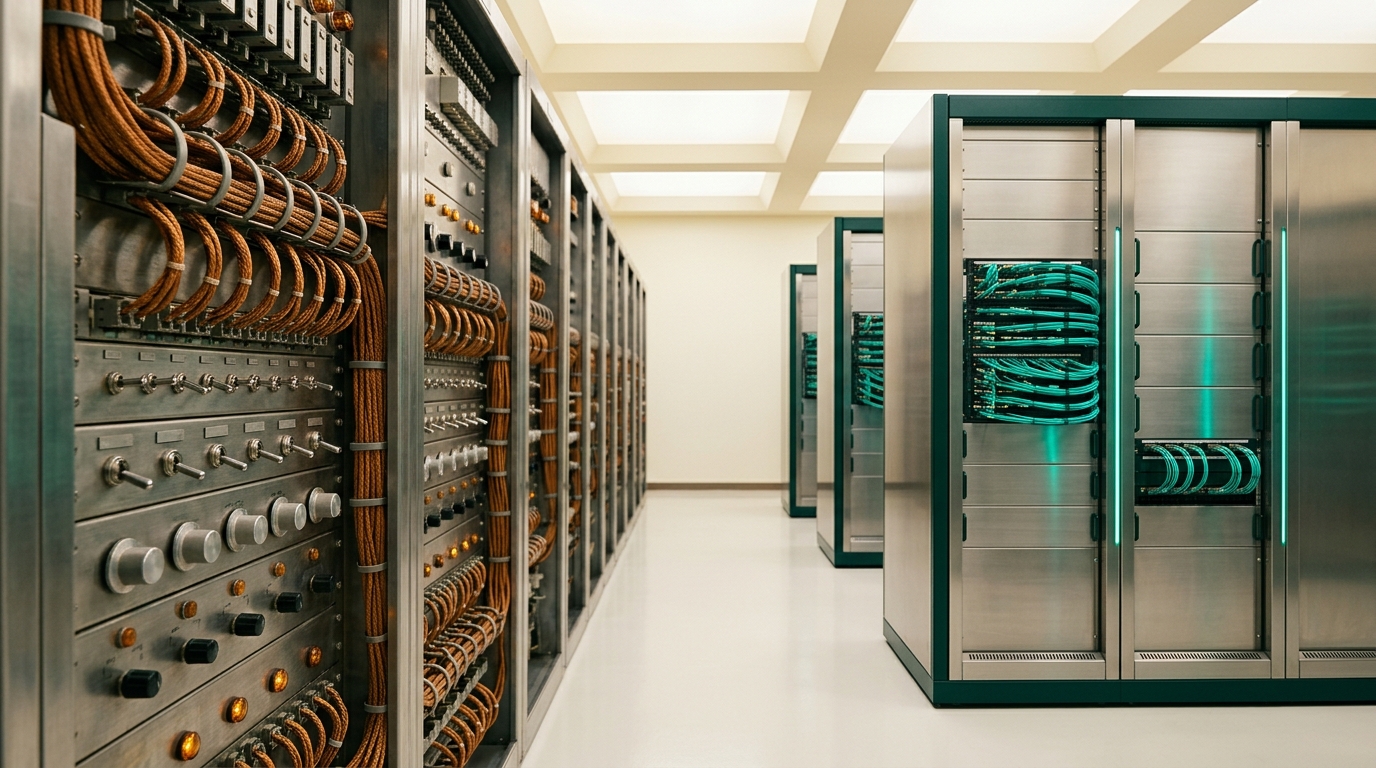
Reactor pressure vessels, containment domes, and main steam condensers were engineered with heavy corrosion allowances that make 60-year and 80-year Subsequent License Renewals (SLRs) metallurgically viable. The nervous system wired into those reactors was never built for eight decades. Across North America and Europe, dozens of commercial nuclear units still execute safety-class Reactor Protection System (RPS) trips and Engineered Safety Features Actuation System (ESFAS) logic using 1970s and early-1980s analog solid-state cards, discrete electromechanical relays, and analog meters (traded globally under HS 9032.89 automatic regulating and controlling apparatus and HS 8537.10 programmable control boards).
Original equipment manufacturers discontinued most of those legacy analog component families twenty to thirty years ago. Electrolytic capacitors dry out, precision resistors drift outside narrow Technical Specification calibration bands, and custom analog comparator boards fail with zero factory stock left on distributors' shelves. Plant engineering departments have kept legacy control rooms alive for two decades through an exhausting patchwork: harvesting cannibalized spares from permanently shut-down reactors, purchasing unverified broker inventory for expensive Commercial-Grade Dedication (CGD), and paying specialty nuclear electronics houses to reverse-engineer obsolete printed circuit boards one small batch at a time.
That defensive strategy hits a structural wall when a utility commits to 20-year life extension out to 2045 or 2055. Reverse-engineering single analog cards solves immediate failure points, yet every manual quarterly surveillance test increases human-error trip risk, stretches refueling outage critical paths, and leaves the station exposed to a single unobtainable power-supply module forcing an extended derate. Modernizing to qualified safety-class digital I&C eliminates analog drift and automates channel self-diagnostics, yet utilities hesitate for a brutally rational reason: in commercial nuclear power, swapping $24 million of control cabinets turns into a $145 million, five-to-eight-year regulatory marathon.
"In a nuclear safety-class digital I&C upgrade, physical cabinets, processors, and fiber-optic modules represent just 16.6% of total project cost; software V&V, NRC Common-Cause Failure review, 10 CFR 73.54 cyber isolation, and outage cutover drive a 6.04x multiplier."
Energy Solutions Intelligence, Twin-Unit Digital I&C CapEx Model (SC-254, Nov 2026)
2. The Oligopoly of NRC-Qualified Safety-Class Digital Platforms
Unlike conventional industrial automation, where a factory can buy off-the-shelf Siemens, Rockwell, or ABB PLCs inside twelve weeks, nuclear safety-class protection systems require generic regulatory Safety Evaluation Reports (SERs) proving deterministic failure behavior under seismic, electromagnetic, thermal, and radiation design-basis loads. Because securing a fresh generic topical report from the U.S. Nuclear Regulatory Commission (NRC) or European nuclear regulators takes years and tens of millions of dollars in vendor verification overhead, commercial global supply concentrates into five qualified platforms, detailed in Table 1.
| Digital Platform | Primary Vendor | Core Hardware Architecture | NRC / Regulatory Standing | Delivery Window (Mos) | Est. 2-Unit Full Upgrade ($M) | Primary Fleet Niche & Constraint |
|---|---|---|---|---|---|---|
| TELEPERM XS | Framatome | Deterministic microprocessor safety PLC | NRC SER Approved (Oconee precedent) | 48 - 72 | $130 - $165 | Installed across >80 reactors globally; deep European & U.S. PWR footprint |
| Common Q | Westinghouse (ABB AC160 base) | Microprocessor safety PLC | NRC SER Approved (topical report) | 48 - 72 | $125 - $160 | Standard on AP1000 & Westinghouse PWR upgrades; lifecycle component refresh |
| Tricon TMR v10/v11 | Schneider Electric | Triple Modular Redundant (TMR) PLC | NRC SER Approved | 36 - 60 | $95 - $140 | Proven on Diablo Canyon safety upgrades; strong fault-voting architecture |
| RadICS | Radiy / Curtiss-Wright | FPGA hardware-logic safety platform | NRC SER Approved (2019) | 36 - 54 | $85 - $130 | Eliminates OS/software execution loop; lowers CCF & cyber friction |
| Spinline / Numac | Rolls-Royce / GE Hitachi | Safety PLC / BWR neutron monitoring | Regional / BWR qualified | 36 - 60 | $70 - $120 | Strong EDF French fleet & BWR neutron flux niche; smaller U.S. multi-system base |
Even with pre-approved generic platforms, vendor engineering capacity is tightly capped. The exact same small pool of nuclear I&C software verification engineers at Framatome, Westinghouse, Curtiss-Wright, and Schneider Electric must simultaneously deliver operating-fleet life-extension retrofits (such as Constellation's multi-unit Limerick modernization and European EDF grand carenage upgrades) while designing first-of-a-kind digital control architectures for new-build AP1000s, EPRs, and Small Modular Reactors (SMRs). Hardware manufacturing inside nuclear-qualified cleanrooms takes 18 to 24 months once design freezes occur, yet engineering queues for site-specific application logic, Factory Acceptance Testing (FAT), and regulatory Request for Additional Information (RAI) responses routinely stretch total execution to 5 to 8 years.
Sub-tier semiconductor obsolescence even stalks digital nuclear platforms themselves. Microprocessor families selected during early 2000s topical report filings often face end-of-life notices from commercial fabless chipmakers within 10 to 15 years. Vendors must therefore execute periodic "technology refreshes" (such as migrating Common Q processor boards or Tricon v10 to v11 modules) and re-qualify every revised integrated circuit under NRC Regulatory Guide 1.250 Commercial-Grade Dedication standards so a digital upgrade does not inherit its own obsolescence cliff twenty years before the reactor's 80-year license expires.
3. Anatomy of the 6.04x Cost Multiplier: Licensing, Cyber & Outage Cutover
Utility CFOs routinely experience sticker shock when comparing an industrial combined-cycle gas turbine distributed control system ($6 million to $12 million installed) against a twin-unit nuclear safety-class RPS/ESFAS modernization ($125 million to $165 million, modeled here at a $145.00 million benchmark aligned with U.S. Department of Energy cost-shared fleet modernization benchmarks). Figure 1 breaks down where every dollar goes.
Source: ESI Nuclear Digital I&C CapEx Benchmark Model (SC-254, Nov 2026), calibrated against DOE/Constellation Limerick and Duke Oconee full safety-system modernization scope.
Four interlocking institutional gates generate that 6.04x multiplier:
1. NRC License Amendment Requests (10 CFR 50.90 & ISG-06): Replacing a safety-related analog RPS channel with software-driven logic cannot routinely hide behind standard 10 CFR 50.59 plant-modification screening when it introduces a new digital Common-Cause Failure (CCF) mode. Preparing an ISG-06 License Amendment Request, commissioning independent Verification and Validation (IV&V) teams to audit every line of safety application code, and answering multi-round NRC Requests for Additional Information absorbs an estimated $58.00M (40.0% of total project cost) across 24 to 48 months.
2. Deterministic Cybersecurity Isolation (10 CFR 73.54 & RG 5.71): Analog copper relays cannot be infected by malware over Ethernet. Every digital protection processor immediately becomes a Level 4 Critical Digital Asset (CDA) under NRC rule 10 CFR 73.54. Utilities must engineer hardwired, unidirectional optical data diodes (enforcing physically one-way outbound telemetry to plant monitoring computers), lock down maintenance laptops via air-gapped portable media kiosks, and run rigorous Factory Acceptance Testing (FAT) and Site Acceptance Testing (SAT) before a single cabinet touches plant power. Cyber architecture plus FAT/SAT consumes roughly $19.50M (13.4%).
3. Staged Outage Cutover & NUREG-0711 Human Factors Engineering: Utilities cannot take a $1.72M/day baseload reactor offline for six months to rewire the control room. Instead, engineers pull thousands of Class 1E seismic cables in parallel during prior outages, install pre-tested digital cabinets in staging rooms, and cut over divisions inside tight 25-to-35 day refueling windows. Simultaneously, NUREG-0711 Human Factors Engineering mandates full-scope control-room simulator replication so licensed Senior Reactor Operators (SROs) log hundreds of hours on new soft controls and alarm screens before live energization, accounting for $43.50M (30.0%).
4. Microprocessor PLCs vs. FPGA Hardware Logic: Cracking the CCF Bottleneck
For twenty years, the single sharpest regulatory bottleneck blocking U.S. digital I&C upgrades was software Common-Cause Failure (CCF). In a four-division analog reactor protection system, a random transistor failure in Division A cannot mathematically jump into Divisions B, C, and D at the exact same millisecond. If all four divisions run identical microprocessor operating systems and application software, however, a latent edge-case coding bug triggered by an unusual plant transient could theoretically freeze all four divisions simultaneously. Historically, NRC Defense-in-Depth and Diversity (D3) guidance required utilities deploying microprocessor safety systems to build an expensive, completely diverse backup actuation system (often hardwired analog or a second distinct digital platform) just to survive a postulated software CCF.
FPGA platforms such as Radiy and Curtiss-Wright's NRC-approved RadICS bypass the traditional microprocessor software stack entirely. Protection logic is burned directly into deterministic silicon logic gates using Hardware Description Language (HDL) with zero operating system, zero dynamic memory allocation, and fixed nanosecond scan cycles. Combined with recent NRC policy modernization under SRM-SECY-22-0076 (which permits risk-informed CCF evaluations rather than blind worst-case assumptions) and expanded 10 CFR 50.59 / RIS 2002-22 guidance for targeted replacements, FPGA architectures allow utilities to swap obsolete analog cabinets in 36 to 54 months while sharply cutting software V&V hours and cyber-maintenance overhead.
That technical shift has split the Western nuclear fleet into two distinct modernization camps. Large multi-unit utilities pursuing full 80-year fleet transformation (following Duke Energy's pioneering TELEPERM XS overhaul at Oconee and Constellation's comprehensive modernization at Limerick) commit to full-plant digital architectures integrated with modern human-machine interfaces. Meanwhile, merchant single-unit and mid-sized operators increasingly execute targeted "like-for-like" subsystem swaps (similar to NextEra's staged emergency load sequencer modernization at Turkey Point), deploying FPGA racks or pre-qualified Tricon/Common Q drop-in modules behind hardwired boundaries to stay inside 10 CFR 50.59 licensing pathways whenever feasible.
5. 20-Year SLR Economics & Utility Procurement Playbook
Why do boards still hesitate to approve a $145M digital I&C capital request? Because standard discounted-cash-flow spreadsheets struggle to price tail-risk obsolescence cliffs. Table 2 and Figure 2 compare a 20-year Subsequent License Renewal (SLR) operating window (2026 to 2046) for a twin-unit 2,200 MWe station under two pathways: nursing legacy analog systems along versus executing full safety-class digital modernization.
| Cost Component (20-Yr Undiscounted) | Path A: Legacy Analog Patchwork | Path B: Full Digital Safety Upgrade | Economic & Operational Driver |
|---|---|---|---|
| Upfront Modernization CapEx | $0.00M | $145.00M | $24M HW BOM + $121M NRC LAR, V&V, 10 CFR 73.54 cyber & outage cutover |
| 20-Yr Recurring I&C O&M & Spares | $90.00M ($4.50M/yr) | $42.00M ($2.10M/yr) | Reverse-eng PCBs & manual calibration vs. digital upkeep & cyber audits |
| Expected Forced Outage Losses | $51.48M (30 unit-days) | $8.58M (5 unit-days) | 1.5 vs. 0.25 unit-days/yr @ $1.716M/day (1,100 MWe x $65/MWh) |
| Automated Surveillance Credit | $0.00M | -$18.00M | Continuous digital self-diagnostics extend manual test intervals |
| Total 20-Year Net Cost | $141.48M (+ cliff risk) | $177.58M | $36.10M net gap = 21.0 forced outage days from an unobtainable part |
Source: ESI 20-Year Nuclear I&C Lifecycle Model (SC-254, Nov 2026). Analog bar splits O&M ($90.00M) and forced outages ($51.48M); Digital bar shows net CapEx + O&M + outage minus $18.00M surveillance credit.
The financial math tells an unmistakable executive story. Without counting federal DOE modernization cost-shares or power-uprate capacity gains enabled by sharper digital thermal-margin measurement, full digital modernization carries a $36.10M undiscounted premium over 20 years ($177.58M vs. $141.48M). Yet at $65/MWh wholesale baseload power (and far higher under 24/7 AI data-center nuclear Power Purchase Agreements), a single 1,100 MWe reactor burns $1.716M every day it sits offline. One unmitigated analog obsolete-card failure that keeps a single unit off the grid for three weeks (21.0 days) while engineers reverse-engineer and dedicate a replacement module completely wipes out the $36.10M savings of deferring modernization. Utilities signing 20-year carbon-free baseload contracts with hyperscalers cannot gamble on 45-year-old relays.
Model Baseload Outage Exposure & Grid Reliability
Benchmark how forced nuclear derates and grid reliability margins translate into regional replacement-power exposure using the Energy Solutions Intelligence Global Reliability Index.
6. Methodology & Open Reproducible Dataset
All CapEx multipliers, platform lead-time bands, and 20-year Subsequent License Renewal (SLR) cash flows in this brief were calculated in fixed-precision Python Decimal arithmetic. The $145.00M twin-unit modernization benchmark reflects published DOE Light Water Reactor Sustainability (LWRS) and multi-unit U.S. fleet RPS/ESFAS modernization scopes (Limerick and Oconee precedents). Forced outage opportunity cost is modeled transparently at 1,100 MWe x 24 hours x $65/MWh = $1.716M/day per unit, excluding ancillary capacity-market penalties and emergency expediting surcharges.
Download the structured CSV table containing all five safety-class platforms, CapEx component splits, and 20-year lifecycle comparison rows for direct integration into utility capital-budgeting models:
Download Reproducible CSV Dataset (SC-254)7. Primary Regulatory & Technical Sources
- U.S. Nuclear Regulatory Commission (NRC), Interim Staff Guidance DI&C-ISG-06: Licensing Process for Digital Instrumentation and Control Systems and SRM-SECY-22-0076 (Expansion of Current Policy on Potential Common-Cause Failures in Digital I&C Systems). nrc.gov
- U.S. Code of Federal Regulations, 10 CFR 73.54: Protection of Digital Computer and Communication Systems and Networks and NRC Regulatory Guide 5.71. ecfr.gov
- U.S. Nuclear Regulatory Commission, NUREG-0711: Human Factors Engineering Program Review Model and Regulatory Guide 1.250: Dedication of Commercial-Grade Digital Instrumentation and Control Items. nrc.gov
- U.S. Department of Energy (DOE) / Idaho National Laboratory, Light Water Reactor Sustainability (LWRS) Program: Digital I&C Modernization & Limerick Cost-Share Benchmarks. lwrs.inl.gov
- International Atomic Energy Agency (IAEA), Nuclear Energy Series: Instrumentation and Control Systems Modernization in Nuclear Power Plants. iaea.org
Related Nuclear Supply-Chain Research
8. Executive Buyer & Analyst FAQ
Why do nuclear power plants still run 1970s analog instrumentation and control systems in 2026?
Legacy analog reactor protection cabinets are deterministic, physically immune to remote cyber intrusion, and grandfathered under original operating licenses. Replacing them with microprocessor-based digital systems triggers multi-year NRC License Amendment Requests, software Common-Cause Failure analyses, and strict 10 CFR 73.54 cybersecurity architectures, causing many utilities to reverse-engineer obsolete relays and circuit boards until spare-part exhaustion forces full modernization.
How much does a full safety-class digital I&C upgrade cost for a twin-unit nuclear station?
A comprehensive safety-class Reactor Protection System (RPS) and Engineered Safety Features Actuation System (ESFAS) modernization across two gigawatt units typically costs $125 million to $165 million (modeled at a $145.00M benchmark). Physical safety cabinets, racks, and fiber optics account for roughly $24.00M (16.6%), while NRC licensing, software V&V, 10 CFR 73.54 cyber isolation, human-factors simulator retraining, and staged outage cutover consume the remaining $121.00M (83.4%).
Why are FPGA platforms like RadICS gaining share against microprocessor safety PLCs?
Field Programmable Gate Array (FPGA) safety platforms implement protection logic directly in silicon hardware gates without a real-time operating system or sequential software execution loop. That deterministic hardware-logic structure simplifies NRC Common-Cause Failure (CCF) evaluations, reduces cyber attack surfaces under 10 CFR 73.54, and lets utilities replace obsolete analog racks with lower regulatory friction and shorter 36-to-54 month delivery windows.
When does digital I&C modernization pay back during an 80-year nuclear license extension?
On a 20-year Subsequent License Renewal horizon, keeping obsolete analog I&C alive costs an estimated $141.48M across two units in reverse-engineering, manual calibration labor, and recurring forced derates, compared to $177.58M net for full digital modernization. Because a single 1,100 MWe unit loses $1.72M per day when offline, preventing just 21 cumulative unplanned outage days from an unobtainable obsolete analog card closes the entire $36.10M lifecycle gap.