1. Why Nuclear Megaprojects Abandoned Stick-Built Containment
In the 1970s, building a gigawatt nuclear island meant tying tens of thousands of tonnes of rebar by hand inside congested vertical concrete formwork, waiting weeks for pours to cure, and then threading steam generators and reactor vessels through tight equipment hatches one piece at a time. That stick-built civil sequence drove massive on-site labor crowding, low productivity at height, and chronic schedule bloat. Modern Generation III+ reactors (Westinghouse AP1000, EDF EPR) and next-generation Small Modular Reactors (GE Hitachi BWRX-300) invert the sequence through open-top modular construction.
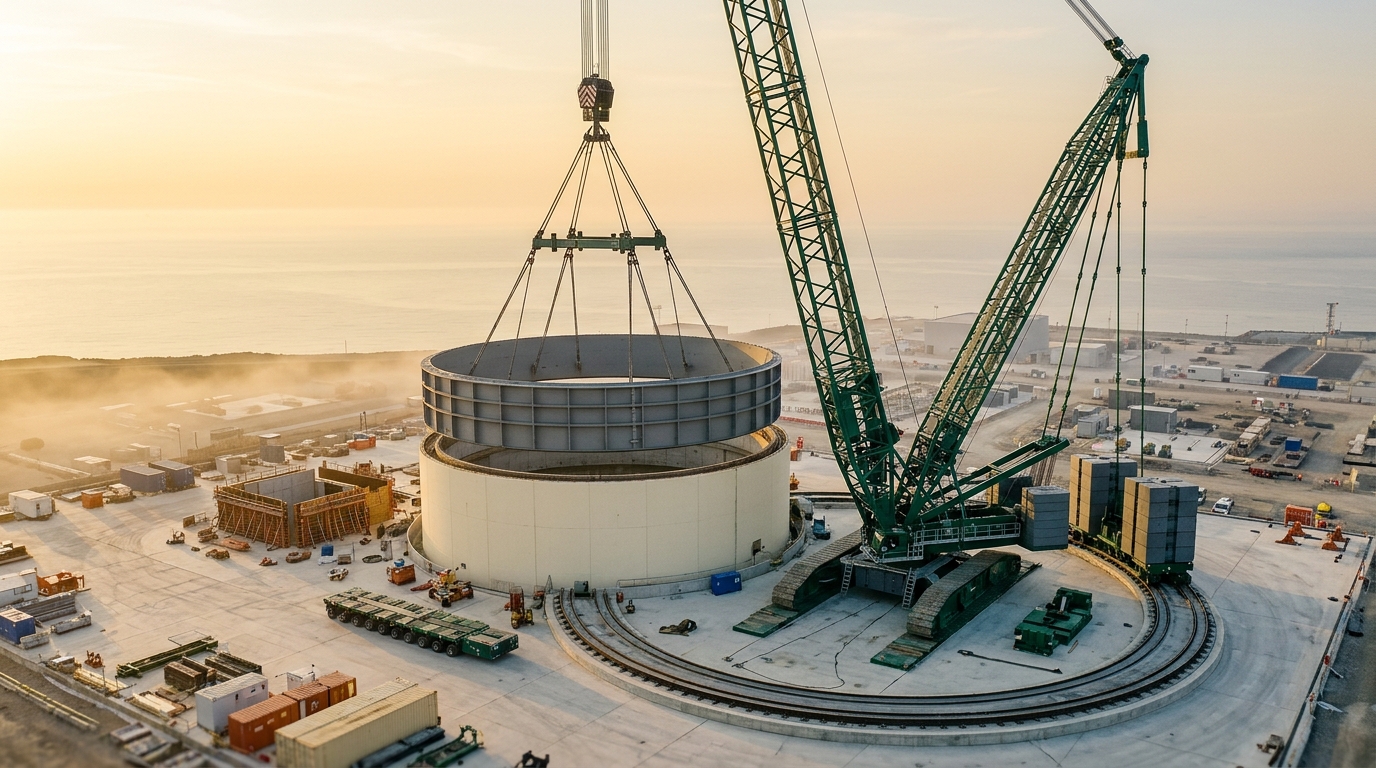
Instead of working sequentially inside a cramped containment cylinder, civil contractors fabricate massive prefabricated structural steel assemblies (traded under HS 7308.90) in weather-protected Module Assembly Buildings (MABs) or off-site shipyards while foundation basemats cure in parallel. Giant self-propelled cranes and ring cranes (classified under HS 8426.41) then hoist entire 300-to-1,600 tonne containment liner rings, internal loop compartments, and reactor pressure vessels straight down through the open roof in single multi-hour picks.
When dimensional engineering is frozen before first concrete, open-top modularization cuts critical-path construction duration by 12 to 24 months and slashes hazardous work-at-height labor hours. Yet heavy modularization also creates two acute physical supply-chain bottlenecks that most energy analysts ignore: a razor-thin global oligopoly in ultra-heavy ring cranes, and an unforgiving millimeter-level fit-up tolerance regime where a single defective factory weld can stall a $12 billion job site for months.
"A $96.8M four-year super-heavy ring crane package pays for itself 8.68 times over if it trims just twelve months of Interest During Construction on a $12B twin-unit nuclear build, yet an 18-month modular fit-up slip bleeds $1.26B in financing costs while the crane sits idle."
Energy Solutions Intelligence, Nuclear Heavy-Lift & IDC Leverage Model (SC-257, Nov 2026)
2. The Global Oligopoly in Ultra-Heavy Ring Cranes
You cannot pick up a 500-to-1,600 tonne nuclear containment liner ring at an 80-to-120 meter outreach radius with an ordinary mobile crane. Standard crawlers tip over long before reaching across a 60-meter-diameter reactor island. Nuclear gigaprojects require custom-engineered ring cranes that rotate on massive 35-to-50 meter circular steel tracks, spreading 5,000+ tonnes of counterweight and live hook load across scores of bogie wheels to keep soil-bearing pressures safe near nuclear excavations. Global ownership of this ultra-class fleet concentrates sharply in two European heavy-lift specialists, Sarens and Mammoet, alongside a tiny pool of Liebherr LR 13000 super-crawlers, summarized in Table 1.
| Crane Platform | Primary Operator / OEM | Max Capacity (t) | Load Moment (t-m) | Nuclear Deployment Window | Est. All-In Package ($M) | Logistics Footprint & Fleet Bottleneck |
|---|---|---|---|---|---|---|
| SGC-250 ("Big Carl") | Sarens | 5,000 t | 250,000 | 48 - 72 mos | $96.80M | 48.5m dual-ring, 128 wheel bogies, 6 km site rail at HPC, 250-280 truckloads |
| PTC 200-DS / 210-DS | Mammoet | 3,200 t | 200,000 | 36 - 60 mos | $82.00M | Containerized ring transport; heavy cross-sector pull from LNG & offshore wind |
| LR 13000 Crawler | Liebherr (Global EPCs) | 3,000 t | 94,400 | 24 - 48 mos | $58.00M | Largest conventional crawler; proven on AP1000 containment rings & steam generators |
| 1,000-1,350t Heavy Crawler | Liebherr LR 11000 / Demag CC 6800 | 1,250 t | 18,000 | 24 - 30 mos | $22.00M | Deep global rental fleet; viable for SMRs capping modules under 250-350 t |
The Hinkley Point C Benchmark: At EDF's twin-EPR Hinkley Point C site in Somerset, UK, Sarens deployed the SGC-250 ("Big Carl") on over 6 kilometers of dedicated site rail tracks so the 5,000-tonne crane could travel fully rigged between Unit 1 and Unit 2 work zones. Simply moving the crane from Antwerp/Ghent ports to Somerset consumed 250 to 280 heavy truckloads, weeks of assembly using multiple auxiliary crawler cranes, and roughly 5,000 tonnes of locally sourced bulk aggregate ballast to avoid shipping dead steel counterweight across oceans. Because these mega-ring cranes are simultaneously booked years in advance for offshore wind monopile marshalling yards, FPSO shipbuilding, and Gulf Coast LNG liquefaction modules, nuclear EPCs that fail to lock a ring-crane reservation 30 to 36 months prior to nuclear island basemat completion risk zero crane availability when their containment liner is ready to fly.
Heavy-Haul Barges & SPMT Bottlenecks: Lifting is only half the movement chain. Moving an 800-tonne CA01 structural module or a 450-tonne reactor pressure vessel from an inland fabrication shop or coastal wharf to the crane hook requires synchronized rows of Self-Propelled Modular Transporters (SPMTs), reinforced heavy-haul bridges, and shallow-draft Ro-Ro ocean barges. Inland nuclear sites lacking navigable river access face hard highway weight and bridge-clearance limits, forcing builders either to construct giant temporary on-site Module Assembly Buildings (MABs) or shrink module geometry to fit standard railcars.
3. Vogtle CA01/CA20 Lessons & The Rise of AISC N690 Steel-Plate Composite Walls
Westinghouse's AP1000 builds at Plant Vogtle Units 3 and 4 in Georgia served as the Western nuclear sector's toughest live laboratory for heavy modular construction. Rather than building conventional reinforced-concrete interior walls, the AP1000 deployed huge Steel-Plate Composite (SC) structural modules: two parallel carbon-steel or stainless-steel faceplates connected by internal tie rods and shear studs, which act as permanent formwork during lifting and become composite shear walls once filled with concrete. The flagship CA01 module (housing the steam generators and reactor coolant compartments, weighing 800 to 900 tons) and CA20 (housing the spent fuel pool and auxiliary rooms) proved that giant open-top lifts were physically achievable, yet first-of-a-kind execution exposed painful industrial pitfalls:
First, incomplete detail engineering meant structural modules arrived from off-site sub-tier fabricators with weld distortions and dimensional errors that clashed with embedded foundation anchor dowels, triggering months of hand-grinding and NRC non-conformance engineering evaluations. Second, lifting and rolling 800-ton open-framed modules out of the Module Assembly Building onto twin heavy-haul transporters induced unexpected structural twisting deflections, forcing engineers to shift to synchronized three-transporter configurations and bolt heavy temporary stiffening trusses onto the modules before every move. Third, densely packed internal steel tie bars inside first-generation SC walls made pouring concrete cleanly without air pockets or honeycombing voids notoriously difficult to inspect behind opaque steel faceplates.
The entire nuclear civil engineering sector absorbed Vogtle's scars and codified the fix into AISC N690 (Specification for Safety-Related Steel Structures for Nuclear Facilities). Rather than hand-welding congested forests of individual tie rods inside custom 900-ton field modules, GE Hitachi's BWRX-300 SMR deploys factory-fabricated Diaphragm Plate Steel Composite (DPSC) blocks ("Steel Bricks"). Internal laser-cut steel diaphragm ribs replace tie bars, leaving open vertical chutes for Self-Consolidating Concrete (SCC) to flow cleanly with minimal vibration, while factory-automated welding ensures millimeter-level fit-up verified via 3D laser scanning prior to shipping.
4. Heavy-Lift Economics: 8.68x IDC Upside vs. $1.26B Rework Downside
Why do gigawatt nuclear EPCs willingly sign ~$100 million crane contracts? Because in capital-intensive nuclear finance, Interest During Construction (IDC) dominates every line item. Table 2 and Figure 1 model a $12.0 billion twin-unit gigawatt nuclear project carrying a 7.0% annual financing rate ($840.00 million/year, or $70.00 million/month in pure interest accrual).
| Economic Scenario | Crane Class & Duration | Direct Lift Package ($M) | Schedule / IDC Impact ($M) | Key Financial Ratio | Strategic Operational Takeaway |
|---|---|---|---|---|---|
| GW Ring Crane Base Case | 5,000t Ring (48 mos) | $96.80M | Mob $18M + Rail $14M + $64.8M | 0.81% of $12B CapEx | Small share of total CapEx if booked 36 mos ahead of basemat |
| 12-Month Schedule Acceleration | Open-top modular success | $96.80M | +$840.00M IDC saved | 8.68x ROI | Just 1 year saved pays for the ring crane nearly nine times over |
| 18-Month Tolerance Rework Slip | Vogtle-style fit-up delay | +$24.30M standby | -$1,260.00M IDC bleed | $70.0M/mo burn | Unfrozen drawings turn heavy-lift cranes into idle cost traps |
| SMR DPSC Standardized Lift | 1,250t Crawler (30 mos) | $22.00M | Mob $4.5M + Pad $2.5M + $15M | -77.3% lift CapEx | Eliminates ring-crane oligopoly queue via <350t module cap |
Source: ESI Nuclear Heavy-Lift & Financing Model (SC-257, Nov 2026). IDC modeled at 7.0%/yr simple carry on $12B twin-unit baseline ($70.0M/month).
5. The SMR Lifting Envelope Advantage & EPC Procurement Playbook
Figure 2 visualizes the structural design revolution separating gigawatt mega-builds from standardized SMRs. Once a single prefabricated reactor module or containment liner exceeds roughly 400 to 600 tonnes at working reach, the project exits the competitive global crawler-crane rental market and enters the five-year booking queue of Sarens and Mammoet ring cranes. By deliberately engineering every DPSC Steel Brick wall block, steam generator skid, and compact pressure vessel below a 250-to-350 tonne lifting envelope, SMR builders can execute parallel site builds across North America and Europe simultaneously using standard 1,000-to-1,350 tonne heavy crawlers ($22.00M per 30-month site package, 77.3% lower lifting CapEx than a gigawatt ring crane).
Source: ESI Nuclear Heavy-Lift Fleet Audit (SC-257, Nov 2026). Nominal maximum crane capacities decline steeply with horizontal boom outreach radius across containment walls.
Whether deploying a 1,600 MWe EPR or a 300 MWe SMR, nuclear project owners must enforce one iron discipline learned from Vogtle Units 3 and 4: never pour first nuclear concrete until detailed modular drawings are 90%+ complete, 3D laser-scanned digital mock-ups have verified zero rebar-dowel clashes, and heavy-lift transport routes from factory to crane pad are physically surveyed. Modularization magnifies good engineering into 8.68x financing savings, and magnifies unfinished engineering into billion-dollar standby traps.
Model Nuclear IDC Sensitivity to Construction Schedule
Test how a 12-month modular schedule acceleration or 18-month tolerance slip alters project IRR and LCOE using the Energy Solutions Intelligence Project Finance Model.
6. Methodology & Open Reproducible Dataset
All heavy-lift package budgets, IDC carry calculations, and SMR lifting savings were verified in fixed-precision Python Decimal arithmetic. Crane lifting capacities, load moments, and mobilization metrics reflect published Sarens SGC-250 (Hinkley Point C deployment), Mammoet PTC 200-DS, and Liebherr LR 13000 technical specifications. Financing sensitivity models a representative $12.0B twin-unit gigawatt project at 7.0%/year simple Interest During Construction ($70.0M/month) to isolate schedule leverage transparently.
Download the structured CSV dataset covering all crane classes, AP1000/BWRX-300 modular wall systems, and heavy-lift IDC scenarios:
Download Reproducible CSV Dataset (SC-257)7. Primary Engineering & Industry Sources
- American Institute of Steel Construction (AISC), ANSI/AISC N690: Specification for Safety-Related Steel Structures for Nuclear Facilities (Appendix N9: Steel-Plate Composite Walls). aisc.org
- Sarens Group & EDF Energy, SGC-250 ("Big Carl") Technical Specifications & Hinkley Point C Containment Liner Ring Heavy-Lift Milestones. sarens.com
- Mammoet, PTC 200-DS / PTC 210-DS Containerized Ring Crane Technical Specifications & Nuclear Heavy-Lift Case Studies. mammoet.com
- U.S. Department of Energy (DOE) & Westinghouse / Bechtel, Pathways to Commercial Liftoff: Advanced Nuclear & Plant Vogtle Units 3 & 4 Modular Construction Lessons Learned. liftoff.energy.gov
- U.S. Nuclear Regulatory Commission (NRC) / GE Hitachi, BWRX-300 Diaphragm Plate Steel Composite (DPSC) Modular Structural Topical Filings. nrc.gov
Related Nuclear Supply-Chain Research
8. Executive Buyer & Analyst FAQ
How much does it cost to mobilize and charter a super-heavy ring crane for a nuclear power plant?
Deploying a 3,200-to-5,000 tonne class ring crane (such as Sarens SGC-250 or Mammoet PTC 200-DS) across a 48-month twin-unit gigawatt nuclear build costs roughly $96.80 million all-in: $18.00M for ocean and 250-to-280 truckload mobilization, $14.00M for compacted civil rail tracks and local ballast, and $64.80M in charter and crew fees at $1.35M per month.
Why did AP1000 modular construction struggle at Plant Vogtle Units 3 and 4?
First-of-a-kind AP1000 structural modules such as CA01 (800-to-900 ton reactor loop compartment) and CA20 suffered from late design completion, internal tie-bar weld congestion, dimensional interferences with foundation rebar dowels, and structural deflections during heavy-haul transport. Those fit-up issues forced costly on-site rework while Interest During Construction bled tens of millions per month.
What are Diaphragm Plate Steel Composite (DPSC) Steel Bricks in the BWRX-300?
Governed by AISC N690 nuclear steel-composite standards, Diaphragm Plate Steel Composite (DPSC) blocks replace dense manual grids of tie rods inside steel-plate composite walls with factory-welded internal steel ribs. That cleaner internal geometry allows self-consolidating concrete (SCC) to flow without honeycombing voids while keeping module weights under 350 tonnes for standard rail, barge, and crawler-crane handling.
How much lifting CapEx do SMRs save by avoiding super-heavy ring cranes?
Keeping maximum reactor-vessel and structural-module lift weights below 250 to 350 tonnes lets SMR builders substitute globally available 1,000-to-1,350 tonne heavy crawler cranes ($22.00M all-in over 30 months) for scarce 5,000-tonne ring cranes ($96.80M over 48 months), slashing lifting CapEx by 77.3% and eliminating multi-year heavy-lift booking queues against offshore wind and LNG mega-projects.