
Battery Cell Prices Crashed Below $50/kWh, Yet Non-Cell Hardware Now Runs the Schedule
For ten years, utility storage analysts built financial models around one dominant variable: lithium-ion cell cost per kilowatt-hour. By 2026, Chinese cell oversupply inverted the entire economics of utility Battery Energy Storage Systems (BESS). Independent global tracking from Ember Energy confirms that bare core battery equipment shipped out of China has fallen toward $73 to $75/kWh, with raw Chinese LFP cells trading near $45 to $55/kWh[7].
Yet walk onto a real 100 MW / 400 MWh utility construction site in ERCOT, CAISO, PJM, or the UK, and you will see finished concrete pads sitting empty for months waiting on everything except bare cells. Across North America and Europe, turnkey 4-hour containerized BESS budgets still land between $165 and $260/kWh gross, and realistic procurement-to-COD timelines sit at 18 to 24+ months. Why? Because bare cells now account for less than a third of a U.S. domestic turnkey project budget (31.5% in ESI's benchmark model). The remaining 68.5% ($178.0/kWh) and nearly every critical-path delay sit inside five integration layers: harmonic-tolerant medium-voltage (MV) skid transformers, grid-forming Power Conversion Systems (PCS), liquid thermal-management loops, four-tier UL 9540A fire qualification, and U.S./EU tariff-compliant enclosure assembly slots[2][8][10].
Global BESS installations surged past 100 GW per year by mid-2026[3], piling utility renewable firming straight on top of AI data center microgrids. The handful of Tier-1 integrators that control captive AC-block manufacturing, localized U.S. enclosures, and pre-reserved MV transformer slots (led by Tesla Energy, Fluence, Sungrow, Canadian Solar e-STORAGE, Wärtsilä, and Powin) now hold vastly more schedule leverage than commodity cell makers.
Why MV Skid Transformers, Grid-Forming PCS, and Liquid Cooling Dictate Project COD
Three engineering shifts between 2023 and 2026 transformed containerized BESS from simple metal shipping boxes into complex, pre-integrated medium-voltage power plants:
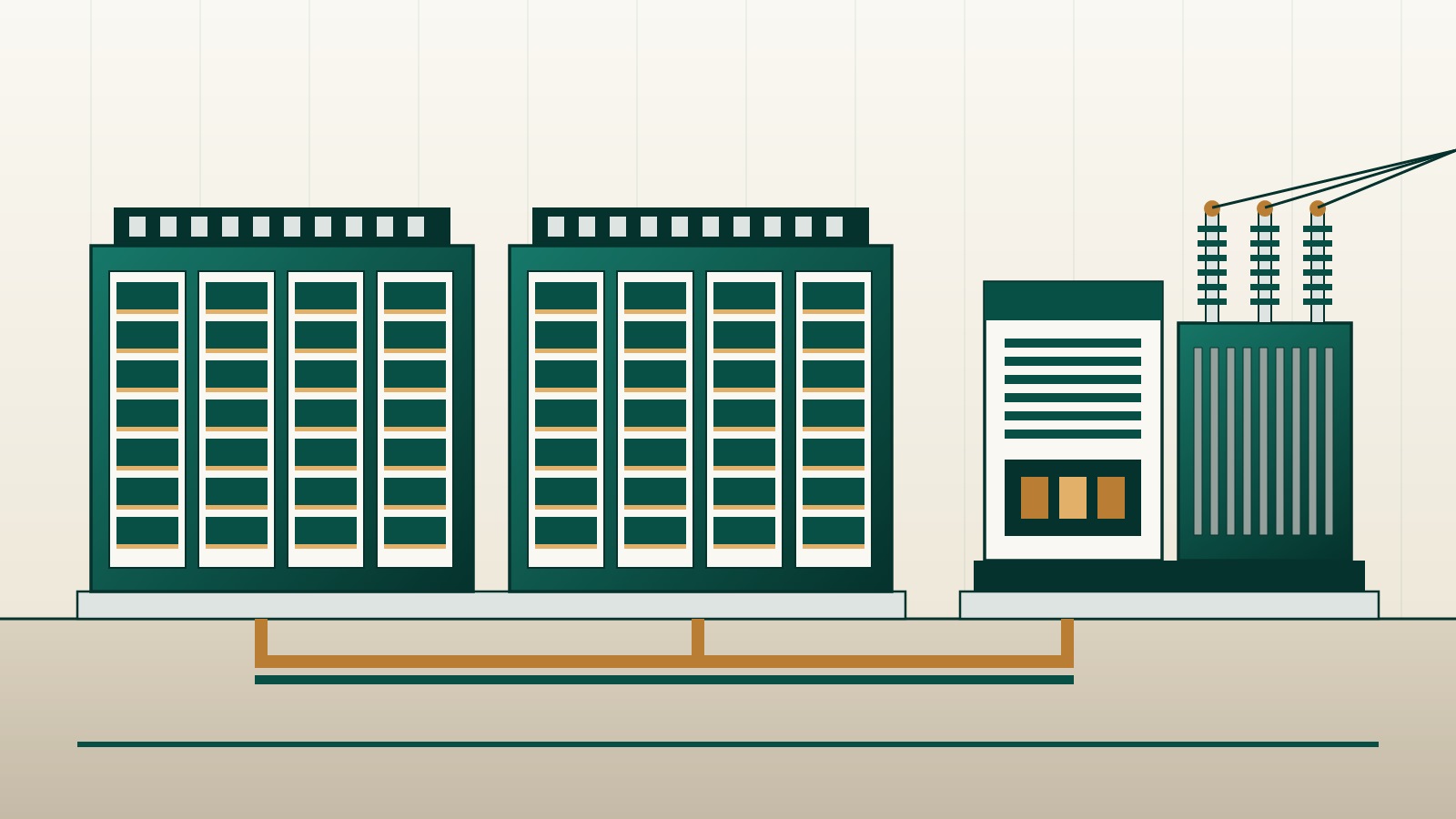
1. Harmonic-Tolerant Medium-Voltage (MV) Skid Transformers (18-30 Month Queues). Modern utility BESS designs couple 4-to-5 MW central PCS inverters directly onto a pre-assembled concrete or steel MV power skid alongside a 34.5 kV (or 33 kV) liquid-filled step-up transformer and ring-main switchgear. Unlike a quiet distribution transformer feeding residential homes, a BESS MV transformer endures bidirectional full-load thermal reversals twice a day plus steep PWM inverter switching harmonics[8]. Standard off-the-shelf distribution transformers overheat and fail prematurely under BESS duty; projects require purpose-built, K-rated, electrostatic-shielded dual-winding or multi-winding transformers[8]. Because those exact medium-power transformer factories are swamped by AI data center substations and grain-oriented electrical steel (GOES) tightness, MV skid transformer queues sit at 18 to 30 months in North America and Europe, outlasting battery cell manufacturing by over a year.
2. Grid-Forming (GFM) PCS Inverters & Silicon Allocation (HS 8504.40). Transmission system operators across ERCOT, Great Britain, Australia, and Germany increasingly require utility BESS to supply synthetic inertia, black-start capability, and low-SCR voltage stabilization via grid-forming PCS inverters[6][14]. Developing IEEE 2800-compliant GFM firmware, validating hardware-in-the-loop PSCAD/EMT interaction models, and sourcing 1,500V DC high-power IGBT/SiC inverter modules inside a non-FEOC Western assembly footprint narrows the qualified PCS pool sharply compared to commodity solar string inverters.
3. High-Density Liquid Cooling Loops (5+ MWh per 20-Foot Container). Packing 5.0 to 6.2 MWh of 314 Ah+ prismatic LFP cells into a single 20-foot ISO footprint eliminated forced-air HVAC completely. Utility integrators now embed closed-loop glycol-water cold plates directly beneath every battery module, keeping cell-to-cell temperature spreads within 2 to 3 degrees Celsius to honor 15-to-20-year degradation warranties. Yet pressurized liquid manifolds introduce factory leak-testing bottlenecks, specialized quick-disconnect couplings, and auxiliary chiller failure modes that lengthen container assembly and Factory Acceptance Testing (FAT) cycle times.
4. DC-Block vs. AC-Block Interface Risk. Developers trying to save 5% to 8% on upfront equipment quotes often split procurement: buying bare DC battery containers from one Asian vendor, central PCS inverters from a second supplier, and MV step-up transformers from a third factory. In tight 2026 supply chains, that split-wrapper strategy backfires during field commissioning. When a BMS Modbus register trips the PCS inverter during a grid-forming fault-ride-through test, each vendor points at the other across continents, burning 6 to 12 weeks of liquidated-damages disputes before the utility grants Permission to Operate. Pre-integrated AC blocks (such as Tesla's Megapack/Megablock or Sungrow's PowerTitan) carry a higher upfront invoice precisely because they collapse that multi-vendor commissioning friction inside the factory gate.
Megafactories vs. Modular Domestic Chains: Tesla, Fluence, Sungrow, e-STORAGE & Wärtsilä
Global BESS integration has consolidated into two competing industrial blueprints: vertically integrated AC-block megafactories (Tesla, Sungrow) versus multi-sourcing localized domestic supply chains engineered specifically for U.S. tax-credit compliance (Fluence, Canadian Solar e-STORAGE, Wärtsilä, Powin).
Tesla Energy (Megapack). Tesla sets the global benchmark for standardized AC-integrated factory velocity. Its energy storage deployments reached a record 46.7 GWh in 2025[1] across a combined ~130 GWh theoretical Megafactory network spanning Lathrop, California (40 GWh), Shanghai, China (40 GWh), and its newest Houston / Brookshire, Texas facility (50 GWh design capacity scaling Megapack 3 and pre-engineered 20-MWh Megablocks). By embedding inverter, thermal loop, and enclosure assembly inside one standardized SKU (and integrating transformer blocks into Megablock), Tesla cuts site EPC installation time dramatically, though U.S. cell localization remains essential to navigate evolving PFE/MACR rules.
Sungrow (PowerTitan). Recognized by Wood Mackenzie in July 2026 as the #1 global AC-integrated BESS supplier as global installations crossed 100 GW[3], Sungrow couples captive world-leading PCS inverter manufacturing directly with its liquid-cooled PowerTitan enclosures[4]. Sungrow dominates Europe, the Middle East, Australia, and Latin America (delivering multi-GWh projects like the 1,243 MWh Hams Hall UK hub), though U.S. Section 48E PFE rules under IRS Notice 2026-15 restrict direct Chinese-origin deployment inside ITC-reliant U.S. projects[9].
Fluence (Gridstack Pro). Fluence engineered the clearest non-FEOC U.S. domestic-content blueprint, shipping its first U.S. domestic-content BESS units in September 2025 by linking U.S.-made cells (Tennessee) with domestic module assembly in Utah and steel enclosures/BMS fabricated in Goodyear, Arizona[2]. That localized footprint propelled Fluence's backlog past $6.4 billion, while simultaneously exposing the real-world execution risk of scaling new U.S. contract-manufacturing lines on schedule.
Canadian Solar (e-STORAGE), Wärtsilä (Quantum) & Powin. Canadian Solar's e-STORAGE delivered a record 7.8 GWh in 2025, entered 2026 with a ~$3.6 billion contracted backlog, and targeted 14 to 17 GWh in 2026 deliveries backed by multi-GWh U.S. utility and data center agreements[5]. Finland's Wärtsilä focuses on complex grid-forming utility markets (UK, U.S., Australia, Chile) pairing its Quantum modular enclosures with its GEMS digital energy platform and multi-decade performance guarantees[6], while U.S. independent integrator Powin competes across North American and APAC utility tenders amid rapid localization pressure.
Decomposing a 100 MW / 400 MWh BESS Across China, Europe, and U.S. Compliance Regimes
Energy Solutions Intelligence decomposed a standardized 100 MW / 400 MWh (4-hour) utility containerized BESS across four regional procurement archetypes (BESS-CN, BESS-EU, BESS-US-IMP, and BESS-US-DOM). All $/kWh cost components and delivery windows are explicitly labeled illustrative (grounded in Ember Energy's core-equipment benchmark[7] and U.S. Notice 2026-15 Section 48E rules[9][12]) and published in the companion CSV.
| BESS Archetype (100 MW / 400 MWh) |
Bare Cells (% Share) |
Encl. & Liquid / PCS & EMS |
MV Skid & BOS / EPC & Soft |
Gross CAPEX (Non-Cell %) |
48E ITC / Net $/kWh |
Net 400 MWh Project CAPEX |
COD Queue (2022 → 26) |
|---|---|---|---|---|---|---|---|
| BESS-CN China Domestic Turnkey |
$46.0 (48.4%) |
$14.0 / $11.0 | $12.0 / $12.0 | $95.0/kWh (51.6%) |
0% / $95.0 | $38.0M | 8 → 10 mo |
| BESS-EU European Utility Turnkey |
$58.0 (35.2%) |
$22.0 / $18.0 | $28.0 / $39.0 | $165.0/kWh (64.8%) |
0% / $165.0 | $66.0M | 12 → 18 mo |
| BESS-US-IMP U.S. Import (PFE Disqual.) |
$78.0 (33.9%) |
$26.0 / $24.0 | $38.0 / $64.0 | $230.0/kWh (66.1%) |
0% / $230.0 | $92.0M | 14 → 22 mo |
| BESS-US-DOM U.S. Domestic Content |
$82.0 (31.5%) |
$32.0 / $28.0 | $44.0 / $74.0 | $260.0/kWh (68.5%) |
40% / $156.0 | $62.4M | 14 → 24 mo |
The policy-arbitrage punchline inside Table 1 is overwhelming. On gross sticker price, a U.S. domestic-content containerized BESS (BESS-US-DOM at $260.0/kWh) costs $30.0/kWh more than a tariffed imported system (BESS-US-IMP at $230.0/kWh) and $165.0/kWh more than a Chinese domestic yard ($95.0/kWh). Yet once IRS Notice 2026-15 disqualifies PFE-heavy imports from Section 48E while awarding compliant U.S. domestic projects a combined 40% Investment Tax Credit (30% base plus 10% domestic content adder), the net cost flips completely: BESS-US-DOM drops to $156.0/kWh net ($62.4 million per 400 MWh), undercutting the disqualified import ($92.0 million) by $29.6 million and even beating unsubsidized European utility pricing ($165.0/kWh / $66.0 million)[9][12].
"In 2026 U.S. utility storage, bare battery cells are barely 31.5% of project CAPEX and the fastest component to deliver; the medium-voltage transformer skid and the IRS Notice 2026-15 MACR certificate run the schedule."
UL 9540A Separation Distances and Contract-Manufacturing Ramp Risk
Two practical field realities explain why even well-funded BESS integrators missed shipment targets across 2025 and 2026:
1. UL 9540A (2025 Edition) Unit Spacing and Explosion Mitigation. Packing 5+ MWh of LFP cells into tighter steel enclosures raises flammable off-gas volume during an induced thermal runaway event. Local fire marshals enforcing NFPA 855 and UL 9540A (2025 updates) demand empirical unit- and installation-level test reports proving zero container-to-container fire propagation and safe deflagration venting before issuing building permits[10][11]. An enclosure platform that passes UL 9540A with zero side-to-side propagation allows tight 3-foot spacing (slashing land area, DC trenching, and pad civil costs), whereas an unproven enclosure forced into 10-foot NFPA 855 default setbacks can disqualify an entire urban or AI-campus substation parcel.
2. Contract-Manufacturing Ramp Friction Inside the United States. Standing up brand-new U.S. enclosure fabrication, busbar harnesses, liquid-manifold brazing, and battery module integration lines (as Fluence and peers executed across Utah, Arizona, and Texas) creates temporary factory ramp bottlenecks, skilled electrical-assembler shortages, and quality-control holds[2]. Developers booking 2027-2028 U.S. CODs must audit whether an integrator's promised domestic assembly slot sits inside an operating factory already shipping commercial containers or a freshly leased contract-manufacturing warehouse still qualifying welding jigs.
3. BMS, EMS & Cybersecurity Compliance (NERC CIP / Utility Grid Codes). Beyond steel and copper, North American and European transmission utilities increasingly scrutinize the Energy Management System (EMS) and Battery Management System (BMS) software layers governing grid-forming BESS dispatch. Utility cybersecurity reviews (aligning with NERC CIP frameworks in North America and NIS2 critical-infrastructure mandates in Europe) require auditable firmware provenance, localized cloud or on-premise telemetry hosting, and zero remote-access backdoors. That software-governance gate further concentrates utility-grade awards into Western-audited EMS stacks (such as Fluence Mosaic, Tesla Autobidder/Microgrid Controller, and Wärtsilä GEMS[6]) even where bare Asian DC containers price lower.
Who Captures Integration Margin Through 2028, and Three Verbatim BESS RFP Clauses
With global cell prices commoditized in China yet non-cell balance-of-system hardware and compliant U.S. assembly slots scarce, pricing power has shifted decisively from bare cell makers to vertically integrated AC-block OEMs and MV transformer suppliers (analytical supply-chain assessment only; not an investment recommendation).
| Supply-Chain Participant | 2026-2028 Structural Position | Observable Industrial Mechanism |
|---|---|---|
| Vertically Integrated AC-Block Leaders (Tesla Energy, Sungrow) |
Highest factory velocity & BOS standardization | 46.7 GWh Tesla deployments[1] & Sungrow's #1 global AC-block rank[3] compress EPC labor via pre-engineered PCS + enclosure skids |
| Localized U.S. Domestic Integrators (Fluence UT/AZ, e-STORAGE, Wärtsilä) |
Strong U.S. 48E / 40% ITC pricing moat | Domestic enclosures, modules & non-FEOC cells protect $29.6M per 400 MWh in federal ITC value over PFE imports[2][9] |
| K-Rated MV Skid Transformer OEMs | Hardest physical schedule gatekeeper | 18-30 month lead times for harmonic-tolerant 33-34.5 kV step-up transformers stall finished battery containers on site[8] |
| Utility & AI Campus Storage Buyers | Must separate MV skid & domestic slot locks | Reserving MV transformer skids and verifying live U.S. assembly lines 20+ months ahead protects COD and 40% ITC tax equity |
"Never let a BESS integrator quote an 'MV transformer excluded, owner-furnished' DC block without confirming your own 24-month K-rated transformer slot first; DC boxes without an AC skid earn zero revenue."
Three Verbatim Questions to Put in Every Containerized BESS Integration RFP
- Trigger 1 (MV Transformer Lead Times Dropping Below 12 Months): Expanded North American and Mexican pad-mounted / K-rated MV transformer winding capacity clearing the current 18-30 month backlog ahead of 2028[8].
- Trigger 2 (Rapid Megablock & Pre-Integrated AC-Block Expansion): Full ramp-up of Tesla's 50 GWh Houston Megafactory alongside Fluence's Utah/Arizona lines creating surplus U.S. domestic-content assembly slots by late 2027[1][2].
- Trigger 3 (U.S. Tariff / PFE Safe-Harbor Relaxation): Regulatory easing of Section 48E MACR enforcement reopening U.S. yards to lower-cost Chinese AC-integrated platforms like Sungrow PowerTitan[3][9].
Methodology, Scope Limitations & Open Dataset
This audit separates observed primary issuer disclosures from ESI project cost modeling. Tesla Energy's 46.7 GWh 2025 deployment record derives from Renewables Now coverage of Tesla filings[1]; Fluence's September 2025 first shipment of U.S. domestic-content BESS (Utah modules, Arizona enclosures) derives from ESS News[2]; Sungrow's #1 global AC-integrated BESS ranking as the market crossed 100 GW derives from ESS News and Sungrow disclosures[3][4]; Canadian Solar e-STORAGE's backlog and shipment guidance derive from e-STORAGE's official portal[5]; Wärtsilä's 2026 grid-forming storage outlook derives from Wärtsilä Energy[6]; global core-equipment pricing baselines derive from Ember Energy (December 2025)[7]; K-rated MV BESS transformer thermal-cycling constraints derive from Nordic Transformer[8]; and statutory PFE/MACR, UL 9540A, and customs classifications derive from IRS Notice 2026-15, UL Solutions, Modo Energy, and USITC Headings 8507.60 / 8504.40[9] through [14]. All sources were verified on or before November 23, 2026.
Scenario Boundaries: Table 1 and Figure 1 model illustrative 100 MW / 400 MWh (4-hour) utility BESS cost stacks ($95-$260/kWh gross) to isolate the non-cell share (51.6%-68.5%) and the post-ITC cost reversal. Shorter 2-hour systems carry higher $/kWh PCS and MV transformer costs (because power hardware amortizes over half the megawatt-hours), while high-voltage 230-345 kV interconnection upgrades, local prevailing-wage differentials, and tax-equity syndication fees shift final project budgets materially.
Open Derived Dataset: All four regional BESS integration archetypes, component-level $/kWh stacks, non-cell shares, Section 48E net CAPEX totals, and delivery queues behind Table 1 and Figure 1 are published in open CSV format: Download CSV Dataset (ESI Containerized BESS Model)
Primary Sources & Verification Registry
Every integrator deployment milestone, core-equipment price benchmark, MV transformer technical constraint, and compliance standard cited in this report links directly to its primary source accessed on or before November 23, 2026.
- Renewables Now (2026). Tesla's 2025 Energy Storage Deployments Hit All-Time High of 46.7 GWh. Reports record global Megapack deliveries and Megafactory capacity scaling across Lathrop, Shanghai, and Houston.
- ESS News (September 5, 2025). Fluence Announces First Shipment of U.S. Domestic Content Battery Storage Systems. Documents Fluence's localized U.S. module (Utah) and enclosure/BMS (Goodyear, Arizona) supply chain.
- ESS News (July 14, 2026). Sungrow Leads Global BESS Integrator Ranking as Market Tops 100 GW. Covers Wood Mackenzie AC-integrated BESS ranking and global annual deployments surpassing 100 GW.
- Sungrow Power Supply Co., Ltd. (2025-2026). Sungrow Official Newsroom & PowerTitan Utility BESS Deployments. Primary project announcements covering liquid-cooled PowerTitan installations across Europe, MENA, and APAC.
- Canadian Solar e-STORAGE (2025-2026). e-STORAGE Official Press & Project Backlog Portal. Tracks utility BESS shipments, contracted backlog, and U.S. grid and data center storage framework agreements.
- Wärtsilä Energy (2026). 2026 Energy Storage Outlook and Opportunities. Examines grid-forming PCS mandates, Quantum modular integration, and GEMS optimization across Western utility grids.
- Ember Energy (December 2025). How Cheap Is Battery Storage? (PDF). Benchmarks Chinese core BESS equipment near ~$73-$75/kWh versus non-cell regional EPC and balance-of-plant stacks.
- Nordic Transformer (2025-2026). Energy Storage Medium-Voltage Transformers Technical Overview. Explains bidirectional thermal cycling, inverter switching harmonics, and why BESS requires purpose-built K-rated MV transformers.
- Internal Revenue Service (IRS) (2026). IRS Notice 2026-15: Material Assistance Provided by Prohibited Foreign Entities (PDF). Statutory MACR framework governing Section 48E 30% ITC and 10% domestic content bonus eligibility.
- UL Solutions (2025-2026). UL 9540A Test Method for Evaluating Thermal Runaway Fire Propagation. Defines cell, module, unit, and installation fire testing governing NFPA 855 container spacing.
- UL Solutions (2025). Inside Look at Updates to UL 9540A (2025 Edition). Technical briefing on updated large-scale outdoor BESS fire and deflagration testing criteria.
- Modo Energy (2026). FEOC Rules, BESS Tax Credits & Non-FEOC Battery Supply Analysis. Quantifies 55% 2026 non-FEOC MACR thresholds and U.S. utility storage tax-credit economics.
- U.S. International Trade Commission (USITC) (2026). Harmonized Tariff Schedule of the United States: Heading 8507.60. Customs classification for lithium-ion battery enclosures, racks, and stationary modules.
- U.S. International Trade Commission (USITC) (2026). Harmonized Tariff Schedule of the United States: Heading 8504.40. Customs classification for static converters and utility BESS Power Conversion Systems (PCS).
Simulate Containerized BESS Sizing, CAPEX & Arbitrage Payback
Model 2-hour versus 4-hour containerized storage stacks, Section 48E domestic-content credits, and dispatch economics with our Industrial BESS Simulator.
Frequently Asked Questions
Why do bare lithium-ion cell prices no longer control U.S. utility BESS delivery schedules?
In 2026 U.S. utility storage, bare cells represent roughly 31.5% of turnkey CAPEX and ship faster than balance-of-plant hardware. Project commercial operation dates are gated instead by 18-to-30 month medium-voltage skid transformers, power conversion system (PCS) inverters, and IRS Notice 2026-15 compliance certificates.
What schedule trap occurs when buyers sign 'MV transformer excluded' BESS DC-block contracts?
Accepting an owner-furnished medium-voltage transformer scope without first securing a 24-month K-rated transformer production slot leaves fully delivered battery enclosures stranded on site earning zero revenue.
Which integrators control bankable domestic and tariff-compliant containerized BESS slots?
Tesla Megapack, Fluence, Sungrow, Waertsilae, and Canadian Solar e-STORAGE lead utility-scale integration, with slot scarcity concentrated in UL 9540A-certified, U.S./EU tariff-compliant assembly bays.
Quote & Cite This Research
Bare LFP cells now represent just 31.5% of a U.S. domestic 4-hour containerized BESS budget while non-cell integration, PCS inverters, and 18-30 month MV skid transformers dominate both CAPEX and schedule. Qualifying for the 40% Section 48E ITC drops domestic turnkey CAPEX to $156/kWh net, saving $29.6M per 400 MWh over PFE imports.